1000 Statues Worked Example
Introduction
I wrote a pretty long article the other day about how to do the interpretive work when handling a sparse text. Almost immediately, someone asked me to do 1000 Statues. It took a few more times for me to finally set aside the time to write it, but here we are. There are no spoilers for my players; feel free to read ahead!
Setting the Stage
For the purposes of understanding the dungeon, let's assume the ruins of 1000 Statues are naturalistic; that is, they were once a real place that had a real purpose and was used by real people. For the players in my 1000 Statues game, they've clued into the fact that this is not how I interpret the text of the module, but I think a naturalistic lens when viewing the text is easy and illustrative. Developing a context for a sparse work is important, almost as important as the work itself. Wolves Upon the Coast has "Fantasy Not-Europe" as its context, so you have a base from which to draw from when you're filling in gaps. 1000 Statues doesn't have that, really, so we'll assume a fairly standard D&D setting with fairly standard setting assumptions and contexts beyond it.
Now let's take a look at the first floor.
Taking a Look: First Thoughts and Observations
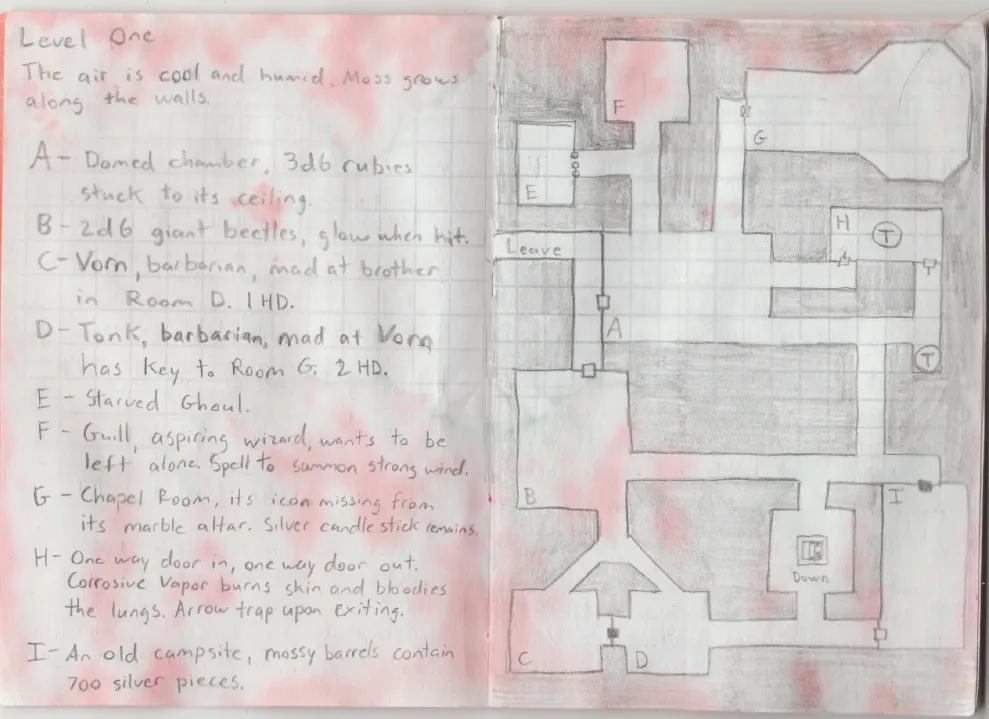
Let's go through the rooms one by one and make some observations. The joy of 1000 Statues is that the map is almost as important as the text, so I'll make references to that as well as the contents of the key.
Room A: This is one of the larger rooms in the level and was probably at one point one of the most ornate. Why are there only 3d6 rubies on the ceiling of a room this big? It's probably been looted many times over (this is supported by the adventurers on this floor) and is probably barren as a result. Maybe would be good to add some rubble or something into the room description, or some trash left behind by previous adventurers.
Room B: It's just a room with 2d6 giant beetles. This is a classic D&Dism; these guys are probably native to the dungeon and might even have a nest in here of some sort. If I thought this level was lacking in treasure, I might add some here or roll up a lair treasure roll in real time while running the game.
Rooms C & D: In my mind, these rooms are so well-connected as to basically be one room. Vorn and Tonk, barbarian brothers who are mad at one another. Why exactly are they mad? That's an unanswered question as of right now (though we'll come back to it later). Vorn is clearly the weaker of the two brothers (he has 1HD, Tonk has 2HD) and he's cornered; if Tonk is truly upset, why hasn't he killed his brother yet? Either he isn't that mad (which seems unlikely, because the text says so) or there's something going on here that isn't immediately obvious. Either way, the difference in HD lets us characterize Vorn and Tonk a little better; I imagine Vorn as a wily, greasy fellow with a scimitar and Tonk as a dumber Conan, big and buff and with a warhammer or greataxe. Maybe there's another room on the floor that can give us some context about their feud. It's also worth noting that the door between the two rooms is stuck. Is it stuck on its own, or did Vorn/Tonk barricade it to keep his brother from breaking the door down and killing the other? The choice of how and why the door is stuck does a lot to characterize the encounter too.
Room E: Just a starving ghoul in this room. We know as students of the D&D Bootcamp that ghouls are undead and eat humans. It's a little ambiguous if the ghoul has starved to death (traditional D&D would say that undead probably don't starve to death, but I'm not your dad) or is just really hungry, but either way I interpret the ghoul as being too malnourished and weakened to fight anything, especially since it doesn't have a HD next to it. How did a single ghoul get stuck in here? Maybe there's another room that can give us some context.
Room F: Guill the magician is the archetypal Big Hat Logan figure, a guy with a book who just wants to be left the hell alone. He's on the other side of the dungeon from Tonk and Vorn, so he probably doesn't know about them and wouldn't want to talk to them besides, and given his proximity to the entrance he's probably a recent visitor to the ruins. Why does he want to be left alone? One option is that he's just like that, which is funny, but we can't really afford to be funny when we have two dangling questions from rooms C/D and E. Maybe he's working on something? It's pretty trivial to say he's working on the ghoul; maybe he's trying to mind control it, or reverse-engineer a ghoul disease. Or maybe he's working on a cure? Whichever option you choose will be up to you tonally, but giving him a purpose based on the existing questions we have solves two birds with one stone. He could also be connected to a place or faction outside of the dungeon that fits in your setting, since he's a learned man and those sorts of people tend to have connections in a classic D&D context. Guill has lots of uses.
Room G: It's interesting that there's a chapel here. The word "chapel" to me implies Christianity, although in D&D it usually isn't this. What idol was taken from the chapel? You could seed this in somewhere in another POV, and add a miraculous effect to bringing the idol back. Maybe there's a ritual that can be done here that involves the silver candlestick (alternatively, the silver candlestick can just be a loot item for you to assign a value to). The more interesting question in the naturalist frame is who was here that had a chapel? Why did it fall into ruin? Those are questions this floor can't answer; it's the type of inquiry you ask of the text as a whole.
Room H: What a nasty trap! Who put it here? Why? One option is Tonk and Vorn, though there's nothing to suggest that they would be capable of getting the corrosive gas into the room or setting up the arrow trap (I stylized it as a large ballista in my version of this floor). I don't really like this option. Another option is that Guill set up the trap. It would explain how he got the ghoul into the cell (it was wounded by the trap and the corrosive gas) and Guill explicitly has air magic. I think it's probably better to offset this to a later floor, though, since it doesn't really dovetail with any of the other stuff we've got going on. Sometimes stuff is just trapped.
Room I: An old campsite and 700 silver pieces in a mossy barrel? Hm, something seems off. Why would barrels just have silver pieces in them? Who did the campsite belong to? The obvious answer is that Tonk and Vorn stayed here, using the room as a safe place for deeper expeditions into the dungeon. How does the silver fit into it all? Maybe they got some loot and they're storing it somewhere in here for safekeeping. That still doesn't explain why they're mad at one another... unless one of them has hidden the silver from the other? Maybe Vorn hid the silver pieces from his stronger brother out of greed and Tonk flew into a rage. The standoff between the two brothers is one about money. Only Vorn knows where the money is, and since he's not willing to go toe-to-toe with his brother, might give anyone who helps kill his brother a cut of the profits. Or he might betray them too, Vorn seems like that kind of guy. Either way, I think tying this room to the Vorn and Tonk room creates a nice little narrative that went over really well at my table.
Conclusion
And that's that! It's actually fairly simple. Some floors will be easier than others, and you might find yourself switching between extremely different tones between adjacent floors. That's fine, the dungeon is kind of made like that. I hope my worked example has given you the confidence you need to run something sparse yourself!